
Health News Today, Nov 5: Cinnamon Alert, CVS Split, Salt Swap

In health news today, federal regulators and major medical outlets bring timely updates on pantry safety, pharmacy coverage, heart health, seasonal viruses, and joint supplements for U.S. adults over 45. Ahead of holiday baking, food safety officials added another recalled ground cinnamon brand to a multistate lead warning and flagged an online herbal joint product tainted with a hidden prescription steroid. At the same time, CVS Health announced a historic breakup of its pharmacy and insurance divisions, researchers modeled how a simple salt swap affects cardiovascular deaths, and physicians outlined fall vaccine timing for older adults visiting newborns.
FDA Adds Wise Wife Ground Cinnamon to Lead Public Health Alert
Federal food safety officials expanded their ongoing spice safety warning on November 4 after state laboratory testing found elevated lead in another retail cinnamon product, according to an updated public health alert from the U.S. Food and Drug Administration (FDA). SLR Food Distribution, Inc., of Hicksville, New York, recalled Wise Wife-Brand Ground Cinnamon after samples analyzed by the Connecticut Agricultural Experiment Station measured 2.118 parts per million of lead. The recalled spice comes in a 3.88-ounce (110-gram) clear plastic jar with a black screw-top cap, a Best Before date of 4/25/2027, and UPC 0688474302754, sold across 14 states including New York, Pennsylvania, Ohio, Michigan, Texas, Virginia, and Massachusetts. Because ground cinnamon sits in pantries for months or years, regulators warn that repeated dietary exposure can raise blood lead levels without obvious early symptoms and poses serious neurological risks to babies and young children.
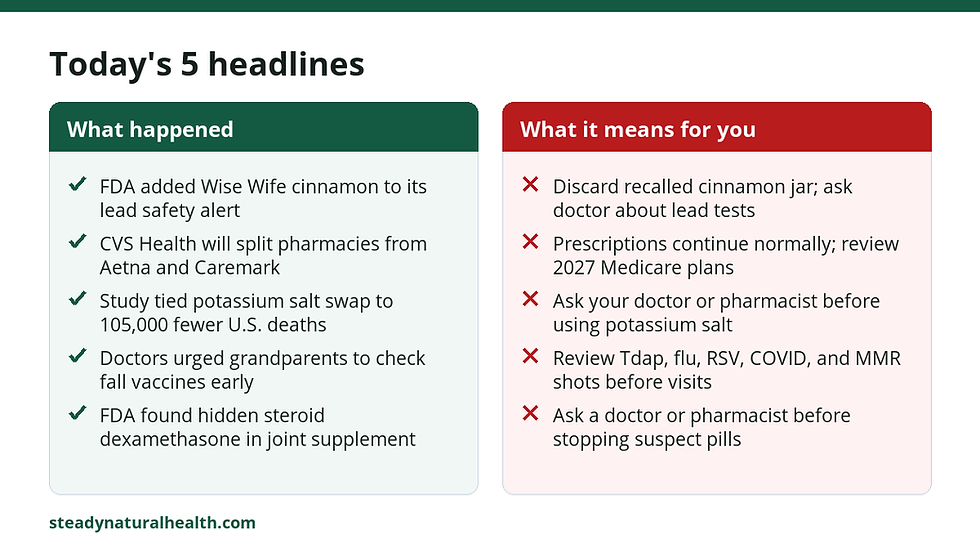
What it means for you: Check your spice rack before holiday cooking and throw away any Wise Wife ground cinnamon carrying Best Before date 4/25/2027 and UPC 0688474302754. If you or visiting grandchildren ate food made with this spice regularly, ask your doctor whether a blood lead check is appropriate.
CVS Health Will Split Retail Pharmacies From Aetna and Caremark
CVS Health announced on November 4 that it plans to divide its $117 billion healthcare conglomerate into two independent publicly traded companies, unwinding nearly two decades of mega-mergers, CNN reported. Under the restructuring, a standalone company named CVS Pharmacy will operate the chain's roughly 9,000 U.S. retail drugstores, 800 MinuteClinic walk-in clinics, mail-order prescriptions, and specialty drug operations. A separate company—called CVS Health in the interim—will house health insurer Aetna, the Caremark pharmacy benefit manager, and senior-focused primary care and in-home health assessment units. Executives expect the tax-free separation to close in early 2028 amid congressional pressure over pharmacy benefit middlemen and rising medical care costs among insured adults. Company leaders said no retail store closures are tied to the announcement and current pharmacy counters and prescription copays will continue operating without immediate changes.
What it means for you: Your local CVS prescription pickups, MinuteClinic visits, and current Aetna or Caremark benefits will continue running as usual while the separation moves toward 2028. Because Medicare Open Enrollment runs through December 7, still review your 2027 plan notice carefully and ask your pharmacist or insurer to confirm next year's covered drugs and preferred pharmacies.
Salt Substitute Swap Could Prevent 105,000 U.S. Deaths Each Year
Replacing regular table salt with potassium-enriched salt could prevent nearly 105,000 deaths and roughly 492,000 new cases of cardiovascular and kidney disease each year in the United States, according to a Nature Health modeling study covered November 4 by Healthline. Researchers at The George Institute for Global Health modeled replacing standard salt across 193 countries with a blend of 75% sodium chloride and 25% potassium chloride, projecting nearly 3 million preventable deaths worldwide annually. While most Americans consume over 3,000 milligrams of sodium daily, potassium helps the kidneys clear excess sodium to lower blood pressure alongside everyday ways to maintain cardiovascular health naturally. However, investigators and cardiologists stressed a critical caveat: for the estimated 37 million U.S. adults with chronic kidney disease, impaired kidneys may struggle to clear extra potassium, raising the risk of dangerous hyperkalemia.
What it means for you: Supermarket salt substitutes containing potassium chloride can help trim daily sodium, yet they are unsafe for certain adults over 45. Before switching from regular table salt, ask your doctor or pharmacist whether your kidney function or blood pressure and heart prescriptions could raise your potassium too high.
Doctors Urge Expecting Grandparents to Check Fall Vaccines Early
With early-season influenza rising faster than usual across parts of the country—including a mutated H1N1 strain—and U.S. measles cases topping 4,500 this year, physicians are urging older adults to review vaccinations well before visiting newborns, CNN Health reported November 4. Babies under 6 months have developing immune systems, cannot receive several routine shots yet, and are too young for antiviral treatments such as Paxlovid. Pediatric and infectious disease specialists cited Centers for Disease Control and Prevention (CDC) guidance advising grandparents and caregivers to check Tdap (for whooping cough, boosted every 10 years), seasonal flu, updated COVID-19, and MMR status for adults born in 1957 or later without clear immunity records. Doctors also highlighted single-dose RSV protection for adults 75 and older—or ages 50 to 74 with conditions like heart disease, asthma, or insulin-treated diabetes—ideally four to six weeks before a baby's arrival.
What it means for you: If you expect a new grandchild or plan holiday visits around infants, schedule a checkup four to six weeks ahead since most shots need about two weeks to build protection. Ask your doctor or pharmacist which seasonal or routine adult vaccines fit your age, health history, and medical records.
FDA Finds Hidden Steroid in Herbal Joint and Muscle Pain Product
Federal regulators warned Flushing, New York–based New Green Nutrition Inc. after laboratory testing uncovered an undeclared prescription steroid inside an herbal product marketed for arthritis, sciatica, rheumatism, and joint pain, according to a warning letter posted November 3 by the U.S. Food and Drug Administration (FDA). Agency scientists analyzed samples of "Qu Feng Huo Luo Dan" purchased from the company's website and confirmed the presence of dexamethasone, a potent corticosteroid omitted from the label. Regulators cautioned that hidden dexamethasone can weaken immune defenses against infection, drive up blood sugar, injure muscle tissue, trigger mood or mental health symptoms, and interact dangerously with everyday prescriptions. The warning letter also cited the firm for selling "Pearl Eye Drops," "Japan Reishi Mushroom Powder," and "Shu Jin Huo Xue Wan" with unauthorized disease-treatment claims online.
What it means for you: Check your medicine cabinet for "Qu Feng Huo Luo Dan" or other imported herbal joint products sold with sweeping arthritis or pain claims. Do not stop a product suspected of containing a hidden steroid abruptly on your own—bring the bottle to your doctor or pharmacist so they can guide safe discontinuation and check for drug interactions.
Related reading: November 4 kale recall and hemp update.
Sources
U.S. Food and Drug Administration (FDA): More Ground Cinnamon Products Added to FDA Public Health Alert Due to Presence of Elevated Levels of Lead
CNN: CVS to split into two companies, in major breakup of its $117 billion healthcare empire
Healthline Health News: Healthier Salt Substitute May Prevent Millions of Deaths From Heart Disease
CNN Health: Expecting a new grandchild? Here's why you may need to see your doctor first
U.S. Food and Drug Administration (FDA): Warning Letter: New Green Nutrition Inc. (MARCS-CMS 737576)
This roundup is for general information only and is not medical advice.
